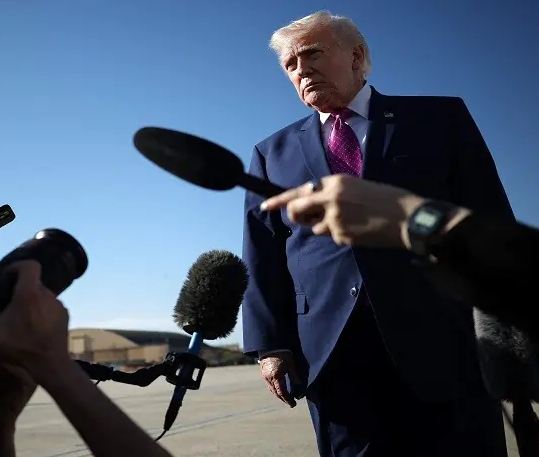
US President Trump talks to reporters before boarding Air Force One at Joint Base Andrews, Maryland, USA, on April 10, 2026.
WASHINGTON: As indirect diplomacy between the United States and Iran converges on Islamabad in the coming hours, the messaging from Washington has settled into a carefully managed tone of cautious optimism-tempered by clear acknowledgment that the process remains fragile.
US President Donald Trump, speaking before boarding Air Force One on Friday evening, projected guarded confidence in the American negotiating team while avoiding any suggestion that outcomes were pre-determined.
“We’ll see how it turns out. So it’s JD and Steve and Jared. We have a good team, and they meet tomorrow. We’ll see how it all works out,” he said, referring to the delegation led by Vice President JD Vance and senior aides.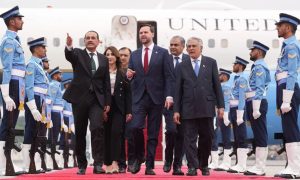
At the same time, Trump framed the talks in explicitly strategic and transactional terms, suggesting that economic and geopolitical interests tied to regional chokepoints would ultimately shape outcomes.
“The strait will open up. If we just left the strait, …(it) is going to open,” he said, adding that the United States itself does not depend on it directly. “We don’t use the strait… other countries will help out.”
Pressed on whether he had a fallback option if diplomacy failed, Trump dismissed the premise outright: “It won’t be easy… but we will have that open fairly soon,” he said. Asked directly about contingency planning, he replied: “You don’t need a backup plan.”
His remarks underscored an approach that blends confidence with unpredictability-placing emphasis on outcomes while leaving the mechanics of negotiation deliberately open-ended. – News Agencies/wire services
About The Author