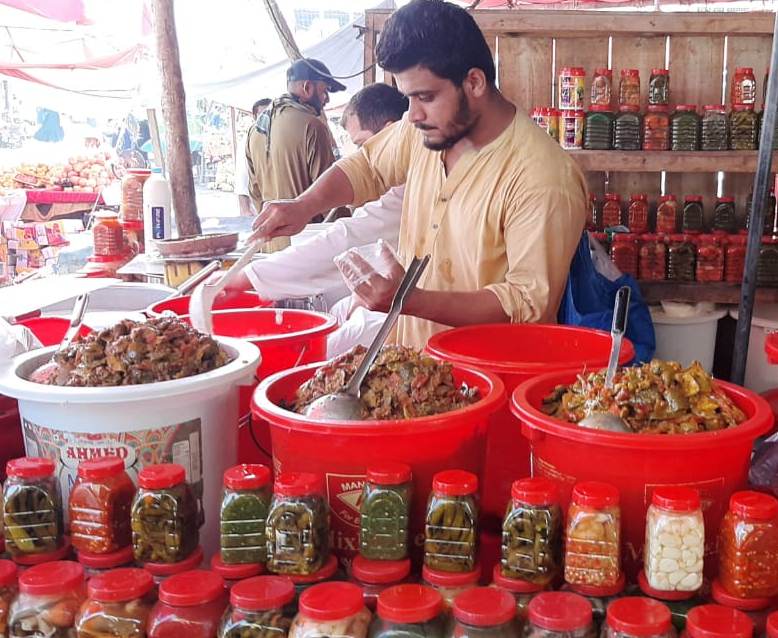
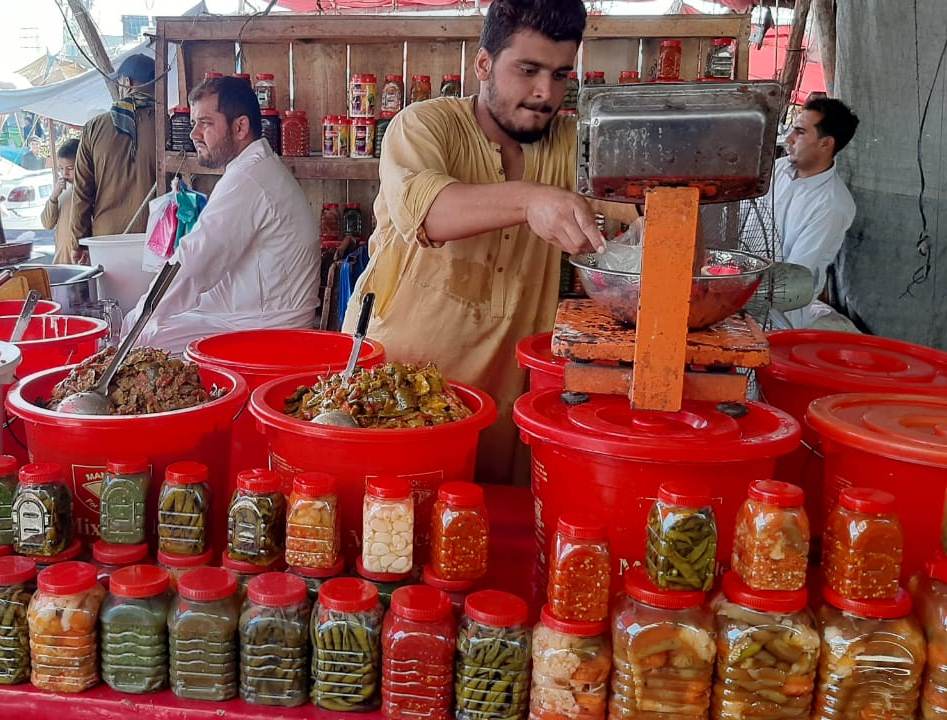
Usman serves customers at his pickle shop in Peshawar's famous Board Bazaar.
By Gul Naaz
Peshawar’s famous Board Bazaar, once known as Little Afghanistan, used to be so crowded that there was hardly any room to stand in the bustling street. Today, however, it presents a scene of emptiness. Once a vibrant center of Afghan culture and cuisine, the bazaar now faces demolition and stands suspended between hope and uncertainty.
The fragrance of spices, pickles, and a variety of Afghan cuisine once drew people from far and wide. But in recent days, dark clouds loom over the future of this market. The Pakistani government’s decision to repatriate Afghan refugees will not only affect the livelihoods of small time shopkeepers and vendors, who have lived here for decades, but may also deprive locals of an essential part of their everyday life.
Among the shopkeepers of Board Bazaar is Usman, who was born and brought up on Nasir Bagh Road in Peshawar. He has been running a pickle shop in the Board Bazaar market for the past three decades. Usman says he feels deep sorrow that the government’s decision to send Afghan refugees back has cast uncertainty over the future of his shop. He believes that if Board Bazaar is shut down, the legacy of Afghan flavors and aromas in Peshawar will come to an end.

The moment you step into Board Bazaar, you sense its atmosphere through its distinct aroma, especially the fragrance of Afghan pickles that draws people in. On Usman’s shop shelves sit colorful jars of pickles made from carrots, chilies, lettuce, and eggplants, all soaked in strong vinegar and rich spices. His shop is more than just a business – it is a treasure chest of his memories.
Usman says, “The flavors I sell here are part of Afghan identity. Our pickles aren’t just food – they are a part of our tradition. When people come to buy them, they become a part of my life.”
But ever since the government began planning the repatriation of Afghan refugees, the bazaar’s hustle and bustle has started to fade. Usman and many other shopkeepers worry about what will happen to their shops and livelihoods if the refugees return to Afghanistan. For Usman, this is not merely a business – it is the work of a lifetime, filled with memories.
He says, “For me, this shop isn’t just a business; it’s a canvas on which I’ve painted the colors of my life.”
Both Afghan refugees and Pakistani customers are fond of Usman’s pickles. “When my Pakistani brothers buy my pickles and tell me they’ve never tasted anything like this before, it makes me very happy,” he says.
For Usman, his pickle shop tells the story of a displaced nation – a people uprooted from their homeland but still deeply connected to their traditions and tastes. To him, this shop is not just a source of income; it is a living symbol of Afghan culture, through which he passes the flavors of his homeland to a new generation.
He says, “When I close my shop at night, I pray that God never lets these bonds, these flavors, and these memories fade away. This soil holds our memories.” Usman and other shopkeepers like him remain hopeful that these bonds of love, culture, and fragrance will continue to live on. His shop – filled with the aroma of Afghan flavors – stands as a powerful symbol of Board Bazaar, a story of a nation’s pain, hope, and dreams.
About The Author