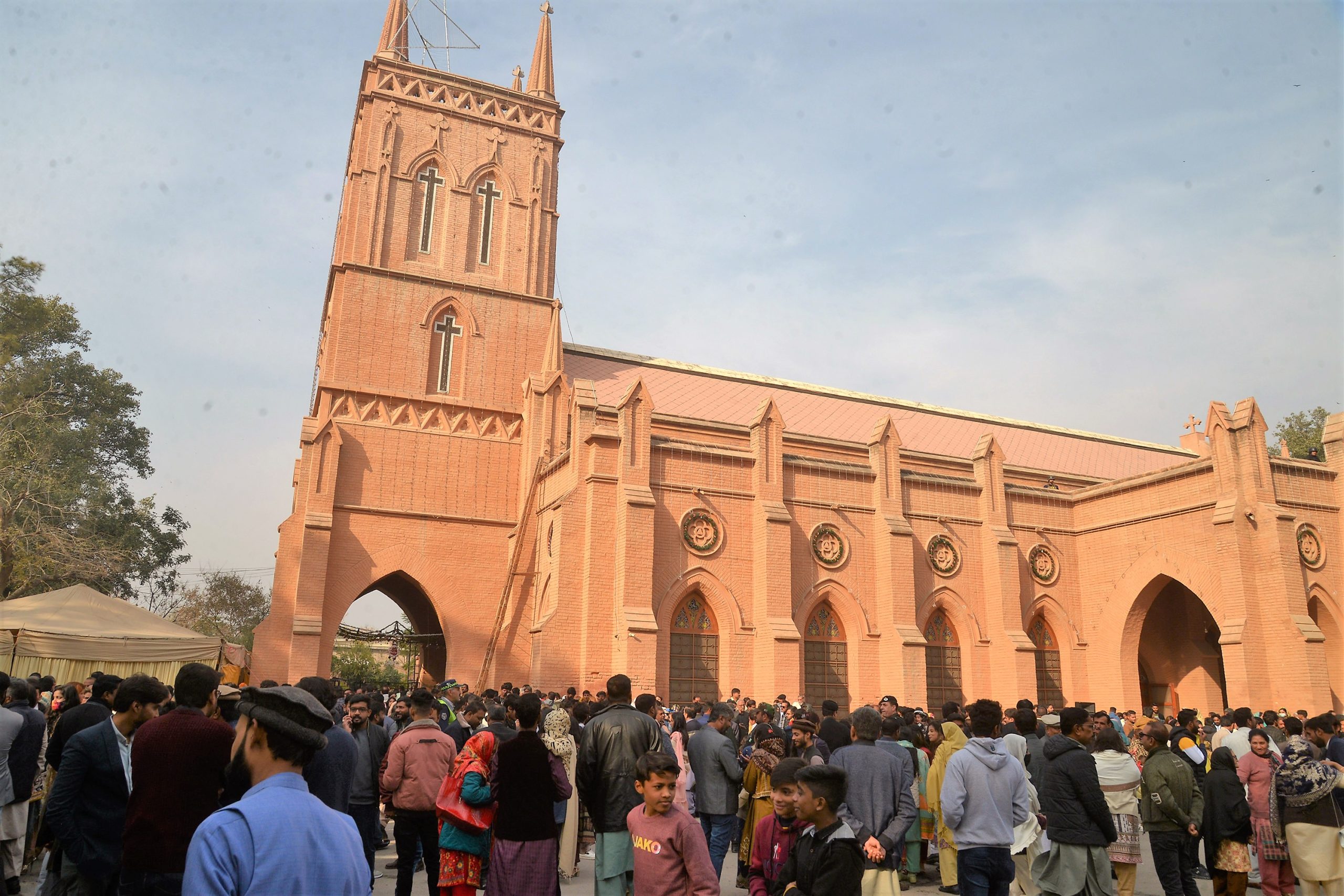
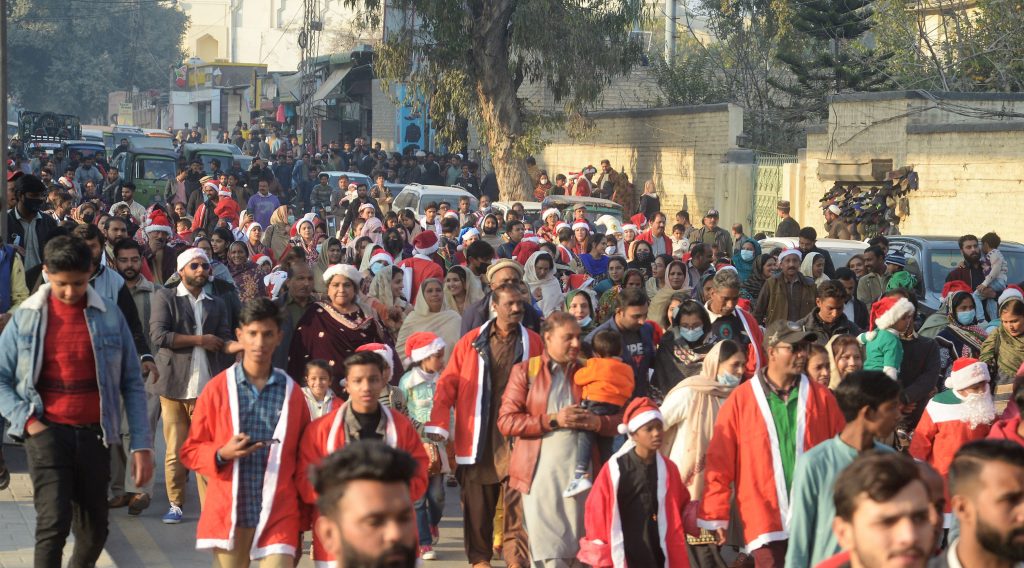
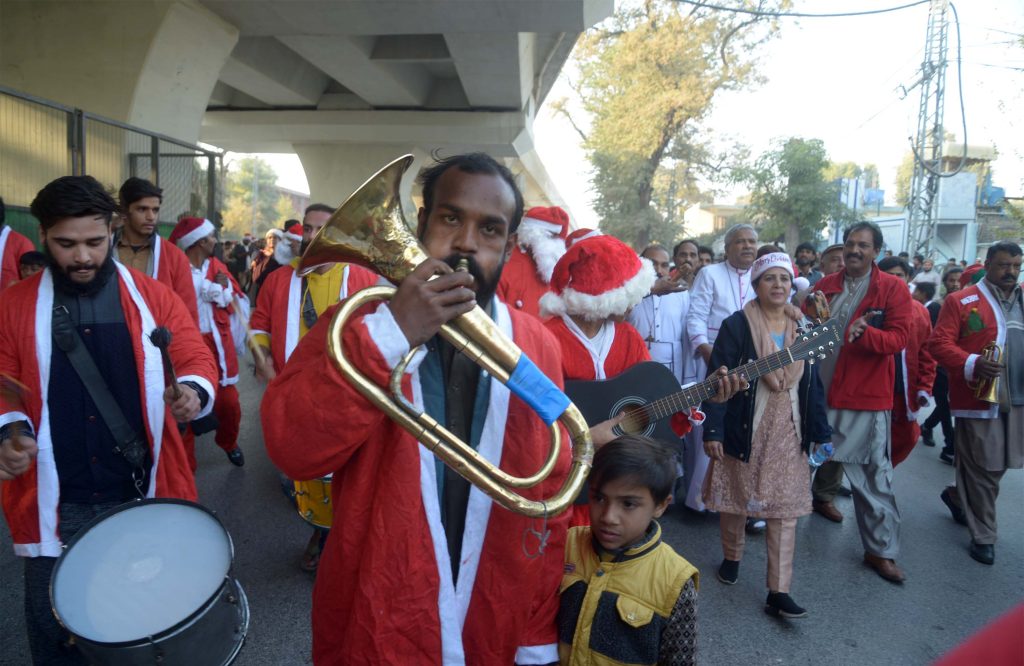
Members of Christian community arrive at St. John's Cathedral Church in Peshawar Saddar for Christmas service.
By Raheela Bibi
PESHAWAR: Hunting for an electric iron cord in Peshawar’s bustling Saddar bazaar, Mr Wilson, who gives only his first name, sounds frustrated with his search and vents his discontent on the current scheme of things in the country.
“I am sick and my family is navigating thorny challenges. On top of this, my two married sons, who worked in the cantonment board as sanitary workers for like eight years, were suddenly thrown out of their jobs,” said 44-year-old Wilson, painting a vivid picture of his family and those of his sons being fallen upon the thorns of life since they lost their jobs a couple of years ago. “Our non-Muslim communities have lost their voice to raise their issues or hardships, like my sons losing their jobs, at proper forums for redressal,” laments Mr Wilson.
In the shadows of a changing socio-political landscape in the country, Mr. Wilson, who polled his vote for the first time in the 2002 general elections, is feeling increasingly disenfranchised with the existing system of political representation of minority communities put in place under the Legal Framework Order (LFO) by military ruler Gen Pervez Musharraf in 2002.
“If we had our own MPA or MNA, we could have brought the issue of my sons’ jobs to his notice. But, now, we don’t know who is representing us in the assembly because we have neither voted for him nor has he ever campaigned for his election”, he said.
“When I was not a voter, I used to go to poll campaigns and the candidates for reserved seats of non-Muslims would go from door to door to mobilize their voters. Now, we have nothing to do with the election or selection of our community representatives in the assemblies”, said Mr Wilson.
In 2002, Gen Musharraf scrapped the 1999 Proclamation of Emergency, whereby the constitution was held in abeyance, and revived the 1973 Constitution with amendments. The Legal Framework Order (LFO) mandated political parties to nominate religious minority candidates through a priority list.
The debate on joint or separate electorates for minorities dates back to the creation of the country, with the 1973 Constitution initially favoring joint electorates. In 1977, religious parties made an alliance named the Pakistan National Alliance and demanded a separate electorate due to the perceived liberal views of PPP, suggesting their influence on minority votes.
In 1985, Gen Ziaul Haq imposed a separate electorate system via amendment in “Representation of the People Act 1976”. According to this amendment, election to the seats reserved for Non-Muslim was made through a direct vote by electors enrolled on the electoral rolls of non-Muslims. Five elections were held under the separate electorate system.
Musharraf’s LFO, introducing a priority list, further marginalized minority communities.
In a significant move in 1996, the government of Prime Minister Benazir Bhutto announced Electoral Reforms, thereby providing the right of dual vote to non-Muslim voters, which means that they would be voters for the reserved seats for non-Muslims as well as general seats for Muslim citizens. However, what the electoral reform seriously lacked was the full right of franchise of the non-Muslims, because they no doubt were being declared voters for the general seats but could not contest elections themselves on the seats known to be general seats. (https://pjia.com.pk/index.php/pjia/article/download/266/296)
According to the 2017 census results, there are 3.63 million non-Muslim registered voters in Pakistan, of which 1.77 million are Hindus, 1.64 million Christians, 167,505 Ahmadis, 8,852 are Sikhs, 4,020 are Parsis, 1,884 are Buddhist and others such as Kalasha community of Chitral.
The 2017 census was held with a gap of 19 years of the previous population census which was conducted in 1998.
The 7th census in the country put the population count at 241.49 million. The population of Khyber Pakhtunkhwa stands at 40.85 million, as per statistics of the Pakistan Bureau of Statistics. The number of non-Muslims has remained slightly below four percent, as per statistics of the Pakistan Bureau of Statistics.
A local priest, Father Shahzad Murad, has also voiced his concern over the existing priority list system for the representation of religious minorities in the country.
“Through the priority list, representatives are imposed on the minority communities as only those candidates are nominated by the political parties who have close links with the party leadership,” Mr. Murad said, adding: “Presently, the representatives of religious minorities have nothing to do with their electors or their issues. They are only loyal to their political parties,” Mr Murad lamented.
“I favor a dual voting right for the religious minorities. In this way, they can vote for their representatives and also vote for candidates on general seats,” Mr Murad said and added: “In the existing system of representation, religious minorities have lost their effective voice to highlight their issues.”
A young Christian political activist, Yasir Bhatti, who supports the Pakistan People’s Party, said that the priority list for the nomination of representatives of non-Muslims in the assemblies has further diminished the voice of religious minorities.
“In the 2018 elections, Wazir Zada, a minority representative on the priority list, was inducted into the provincial cabinet. He hailed from the Kelash community of Chitral. He was completely ignorant of the issues and challenges facing the religious communities,” Mr Bhatti said.
“ I favor the dual voting right for religious minorities as in this way we can directly relate with our representative in the assembly and also cast votes for candidates on general seats. This priority list system has altogether marginalized our communities,” said Yasir Bhatti.
To prove his point, he said that in the past, Pervez KG was a minority MPA in the former NWFP Assembly and he told us about how he used to travel to the far-flung localities to meet his electors.
“Mr. Pervez can tell you even today what problems are being faced by the Christian community in Shangla or any other far- off district of the province, because he had visited them to seek their votes”, he said.
“However, the present procedure of filling reserved seats does not allow it to be so. The representatives selected on the priority list have to follow the mandate and policies of their respective parties and have nothing to do with the issues facing their communities”, Mr Bhatti said.
A former member of the Peshawar district council, Sahib Singh, who had contested the election on the Awami National Party (ANP) ticket, says that the current procedure of filling the seats reserved for non-Muslims is completely flawed. “Those who make it to the assemblies on the priority list of the political parties are completely ignorant of the issues of non-Muslim communities. Through the priority list, the representatives are imposed on the non-Muslims,” said Mr Singh.
Sahib Singh had remained the district member of Peshawar’s district council twice. “I and other candidates would campaign in all the 92 union councils of Peshawar. It used to be similar to the campaign for the National Assembly seat. We would reach out to each of the voters to mobilize them. But, now, the situation is completely changed. The non-Muslim voters have been further marginalized as the political representatives are imposed on them.”
“I favor the separate electorate system because non-Muslim voters directly vote for their communities’ representatives and can convey their issues and problems to them in a better way. The priority list procedure has further marginalized the non-Muslim voters,” said Sahib Singh.
A senior leader of Jamaat-i-Islami (JI), Mr Jamaat Ali Shah, says that the non-Muslim members who make it to the assemblies on the priority list are representatives of their respective parties more than they are representatives of their communities. “We (Jamaat-i-Islami) support the separate electorate system for non-Muslims. It is our principled stance since the inception of the country,” says Mr Shah.
“We consider that the leaders elected on the priority list of non-Muslims are not genuine representatives of their communities”, said Jamaat Ali Shah, adding that even in United India, Jamaat-i-Islami supported the separate electorate system for Muslims because they were in a minority in India.
A spokesman for Jamiat Ulema-i-Islam (Fazl), Abdul Jaleel Jan, says that the JUI (F) supported the separate electorate system for non-Muslims. “In the present priority list system, our party adopts a strict scrutiny process to nominate genuine leaders of religious minorities to the assemblies,” Mr Jan said.
For members of religious minorities like Mr Wilson, the present system has weakened the connection between the political representatives of non-Muslims and their communities, which is a serious cause for concern.
“If we had a separate electorate system, or dual voting right, we could convey our voice to our representatives. But, now, the priority list binds the minority representatives to be loyal to their parties and our issues are left to ignite more concerns among our people,” laments Mr Wilson.
About The Author