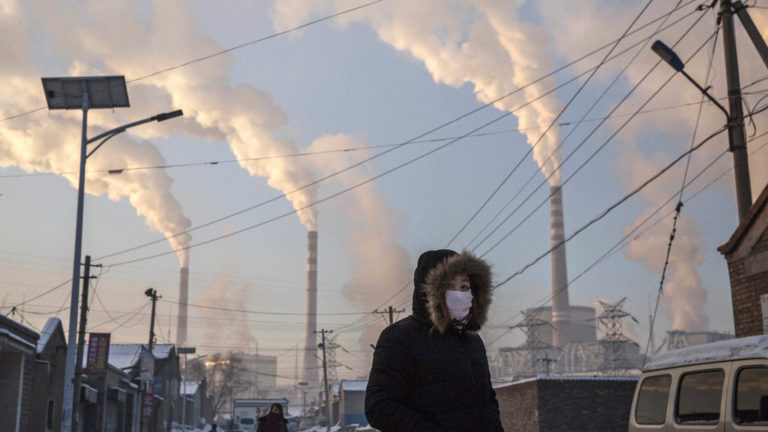
SHANXI, CHINA -NOVEMBER 26: (CHINA, HONG KONG, MACAU, TAIWAN OUT) Smoke billows from stacks as a Chinese woman wears as mask while walking in a neighborhood next to a coal fired power plant on November 26, 2015 in Shanxi, China. A history of heavy dependence on burning coal for energy has made China the source of nearly a third of the world's total carbon dioxide (CO2) emissions, the toxic pollutants widely cited by scientists and environmentalists as the primary cause of global warming. China's government has publicly set 2030 as a deadline to reach the country's emissions peak, and data suggest the country's coal consumption is already in decline. The governments of more than 190 countries are expected to sign an agreement in Paris to set targets on reducing carbon emissions in an attempt to forge a new global agreement on climate change. (Photo by Kevin Frayer/Getty Images)
UNITED NATIONS: Marking the International Day of Clean Air for Blue Skies on Thursday, UN Secretary-General Antonio Guterres issued a clarion call for increased international cooperation to address the “global emergency” of worsening air pollution. Airborne contaminants are one of the most significant environmental health risks, he said.
According to the UN World Health Organization (WHO), 99 per cent of the world’s population breathes polluted air, with the exposure significantly worse in low and middle-income countries.
The pervasive nature of air pollution requires global collaboration, it was pointed out. This year’s theme, ‘Together for Clean Air,’ addresses the urgent need for stronger international partnerships, increased investment, and collective responsibility to cut air pollution. “Global problems require global solutions. We must act together for clean air,” the UN chief added.
“Together, we must accelerate a just and equitable transition away from fossil fuels, particularly coal, towards clean renewable energy, while ensuring that no one is left behind.”
Air pollution is defined as any chemical, physical, or biological contaminant that modifies the natural characteristics of the atmosphere, the UN said.
Household cookers and other combustion devices, cars, industrial facilities, and forest fires are the most common sources of air pollution. Air pollution exists both outdoors and indoors, and both severely impact human health.
Pollutants which are particularly dangerous include carbon monoxide, ozone, nitrogen dioxide and sulphur dioxide, it said.
Air pollution also includes PM2.5, inhalable particulate matter less than 2.5 micrometers in diameter – less than that of human hair. These particulates are invisible to the human eye and can penetrate deep into the lungs where they can cause inflammation, enter the bloodstream, and damage the heart and brain.
Exposure dramatically increases the risk of strokes, heart and lung disease, cancer, and other ailments, leading to over 6.7 million premature deaths annually, according to WHO.
Air pollution also affects plants, reduces crop yields and impacts food security. It worsens social and gender inequality, and slows economic development, limiting the ability of countries to meet their development goals.
“Exposure at any level can have health implications that impair quality of life and come with costs for the individual, our societies, and our economies,” said Martina Otto, head of the secretariat of the UN Environment Program (UNEP)-convened Climate and Clean Air Coalition.
“We’ve tended to express health impacts through the number of premature deaths. But our day-to-day quality of life is affected, too. Air pollution impacts all age groups but those with higher vulnerability suffer the most,” she added.
“Just as reducing air pollution is key to improving human health, it is also key to tackling the triple planetary crisis of climate change, nature and biodiversity loss, and pollution and waste, as well as helping us achieve several Sustainable Development Goals (SDGs),” said Ms Otto.
Solutions to improve air quality vary based on local contexts and sectors. At the individual level, people can initiate change by making decisions that promote clean air, such as making environmentally friendly purchases and using cleaner methods of transportation and cooking.
Businesses and corporations can add air quality to corporate social responsibility considerations, monitor and publicly report pollution emissions, and promote programs that reduce emissions.
Governments should create and enforce air pollution standards to achieve milestones outlined in the 2021 World Health Organization guidelines, in addition to increasing their capacity to monitor air quality, the UN said.
“Together, we must accelerate a just and equitable transition away from fossil fuels, particularly coal, towards clean renewable energy, while ensuring that no one is left behind,” Guterres said.
“Our air is a common good and a common responsibility. Let’s work together to clean it up, protect our health, and leave a healthy planet for generations to come.” The International Day of Clean Air for blue skies was established in 2019 by the UN General Assembly, which recognized the importance of clean air and the impact of air pollution on human health and ecosystems, in particular its disproportionate effects on women, children and older persons. – News Agencies / Web Desk
About The Author