
Political parties, candidates embrace social media to sway KP voters ahead of general elections
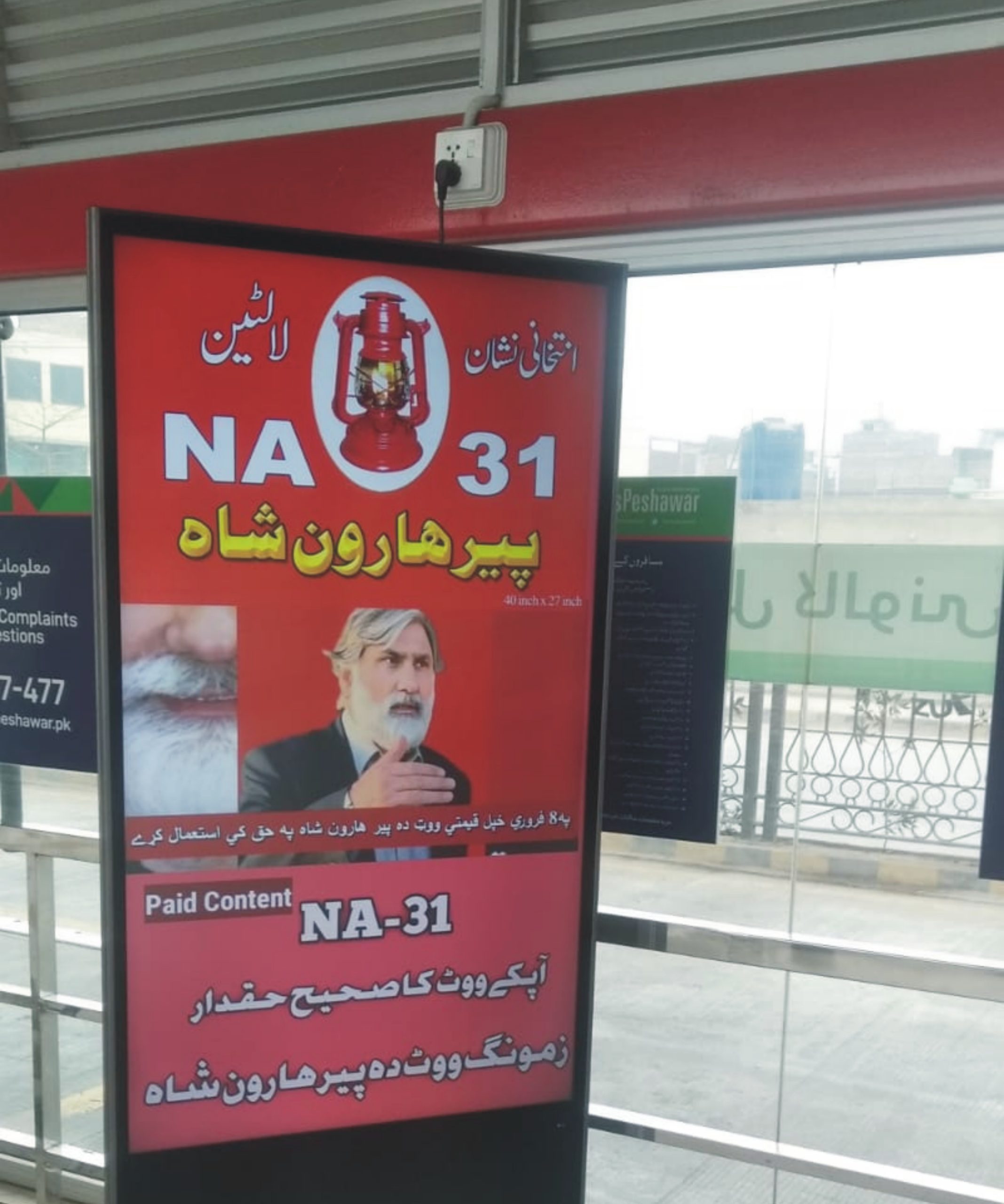
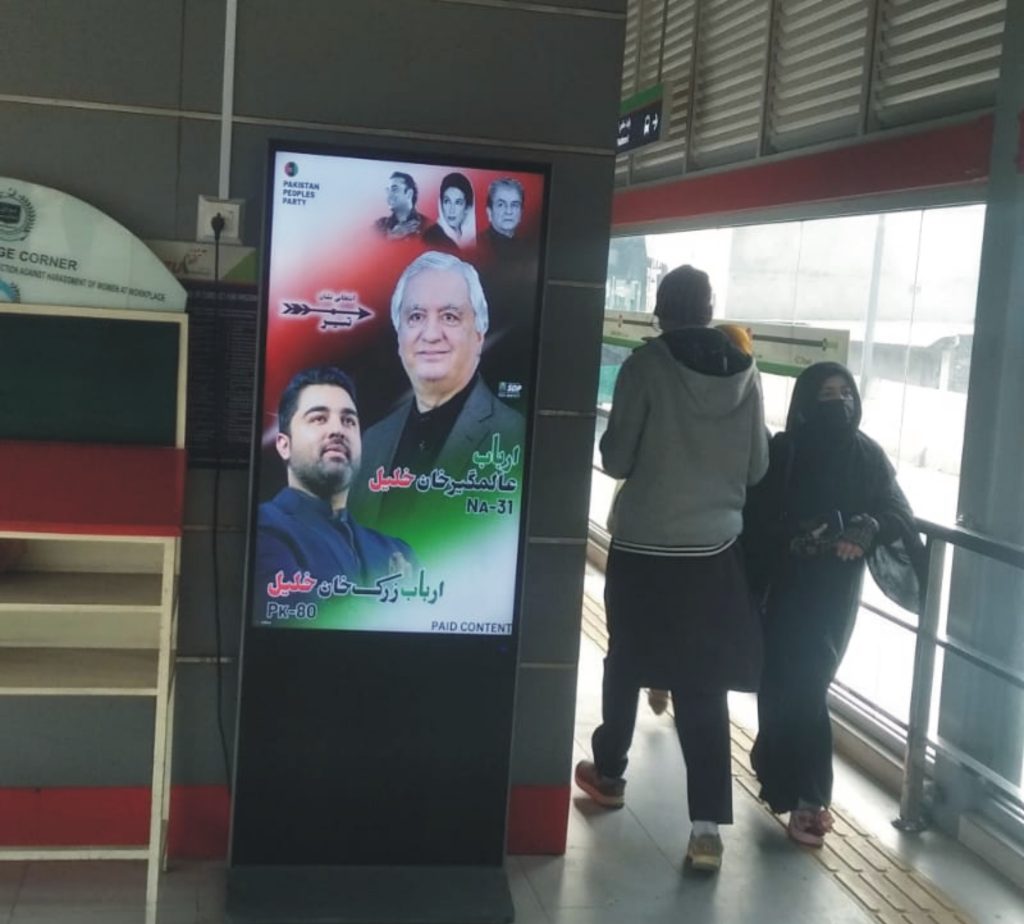
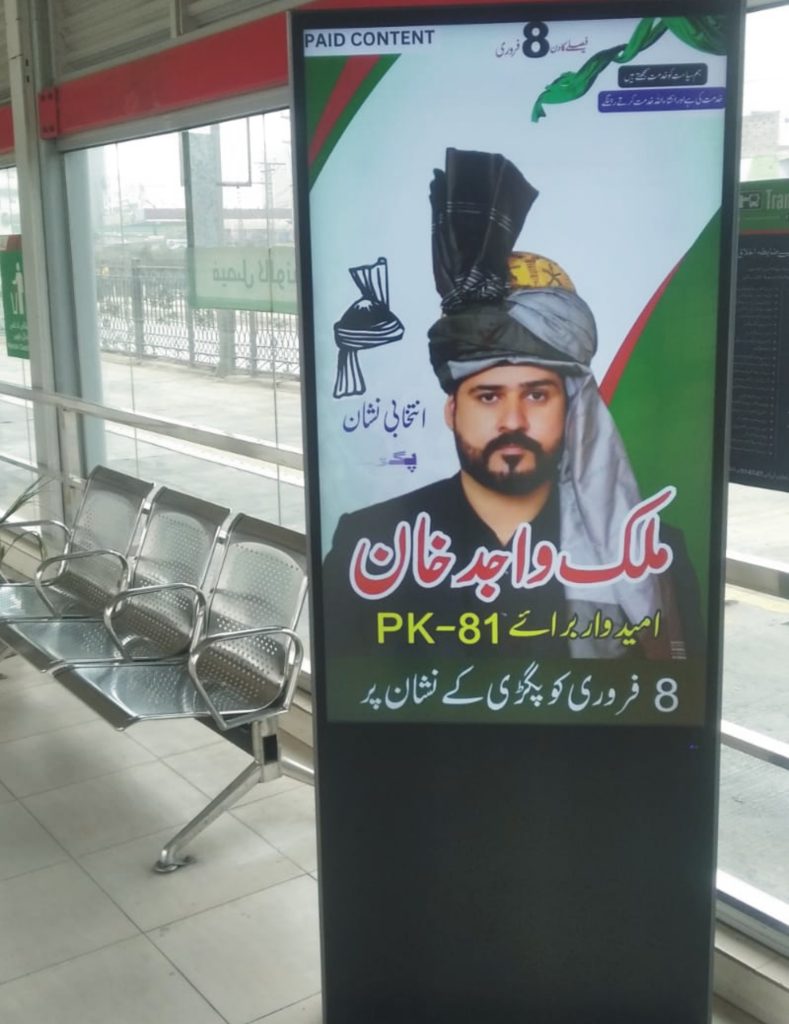
Multi media screen at BRT station in Peshawar
By Raheela
In the humming political landscape of Peshawar, the role of social media in shaping election campaigns has become increasingly prominent, with political parties and candidates recognizing its potential to influence public opinion. As general elections in the country loom, political parties are strategically adapting their poll campaigns to leverage the reach and impact of social media platforms.
Social media activists, including Youtubers and TikTokers, who are affiliated with political parties, opine that the mainstream political parties and leaders not only in Peshawar but also in other
parts of Khyber Pakhtun-khwa perceive social media as a powerful tool to directly connect with voters, which has led to a shift in election campaign strategies.
Rahat Shinwari, a Khyber-based journalist and Youtuber, says that political parties now hire social media teams and form their social media wings to increasingly use platforms like Facebook, Twitter, Instagram, YouTube and TikTok, to disseminate their messages and interact with voters.
Viral speeches and interviews play a crucial role in garnering public support, which is exemplified by the recent popularity of Sher Afzal Marwat, a leader of Pakistan Tehreek-i-Insaf. “On the spur of the moment expression of an abusive term or more plainly an expletive, like “Program to Warr Gia”, suddenly shot a novice political leader to popularity after the term went viral and made rounds on social media,” he said.
Gohar Ali Gohar, a Malakand-based journalist and political commentator, says that local leaders and political parties increasingly rely on social media platforms to influence public opinion.
“Video content and interactive posts are mostly employed to engage a diverse audience,” he says and adds that PTI is the pioneer of social media trends.
“Now, all the mainstream political parties, like PPP, ANP, Jamaat-i-Islami, JUI (F), PML (N) and others have formed teams to capitalize on social media’s influence on opinion-making,” Mr Gohar says and adds that the Jamaat-i-Islami had organized several workshops and training sessions in Malakand Division for its social media teams how to disseminate their party’s manifesto and counter opposition’s narratives.
“In the present era, the role of social media cannot be overstated. Online discussions and trends often spill into mainstream discourse, amplifying their impact on the overall electoral landscape,” says Rafiq Khattak, a Peshawar-based lawyer.
“There is no gainsaying that voters respond actively to political messages on social media. Engagement metrics such as likes, shares, and comments serve as indicators of public sentiment. However, translating this digital engagement into voting behavior remains a complex challenge, requiring parties to bridge the gap between online enthusiasm and offline participation,” states a local journalist, M. Iqbal.
A senior PTI leader, Zafarullah Khattak, says that the increasing reliance on social media has transformed the landscape of political communication not only in Khyber Pakhtunkhwa but also in other parts of the country. “Real-time updates, interactive sessions, and multimedia content have become integral components of poll campaigns,” he adds.
“This shift presents both challenges and opportunities for political leaders, demanding adaptability to the evolving nature of digital discourse and also making it all the more difficult for political workers and voters to differentiate between misinformation and propaganda,” Zafar Khattak adds.
“The effectiveness of social media campaigns in influencing voter sentiments cannot be ignored. The personalized nature of content delivery on platforms, like WhatsApp, TikTok, Facebook, and Youtube, allows for targeted messaging, often surpassing the broad reach of traditional advertising,” says Hidayatullah, an advertising professional.
Rahat Shinwari emphasizes how propaganda can be disseminated with ease, shaping public opinion through candidate profiling, highlighting success stories, and employing propaganda against opponents. “During election periods, social media becomes a battleground where information about candidates’ backgrounds, qualifications, beliefs, and previous tenures is strategically presented to influence voters,” he adds.
According to Gohar Ali Gohar, ordinary users of social media platforms are easily swayed by political discourse and propaganda. “The rival supporters engage in negative interactions, while neutral individuals or saner elements critically evaluate messages, impacting actual voting behavior.”
“The youth, in particular, are susceptible to social media messages, often swayed into opposing or supporting specific parties or leaders based on viral content,” a social media user, Najam Khan (name changed) said, adding it has been exemplified in the popularity of PTI leader Sher Afzal Marwat.
Zafar Khattak says that relying heavily on social media in election campaigns offers unprecedented reach and engagement, yet it comes with inherent risks. “One of the major concerns is the rampant spread of misinformation. Social media can amplify false narratives, influencing public opinion,” he says and adds that social media can lead to polarized discourse, reinforcing existing biases among users and hindering dialogue.
Balancing the advantages of digital outreach with responsible online practices is crucial to upholding the democratic principles of fair and free elections.
In response to this, Pakistan implemented the ‘Removal and Blocking of Unlawful Online Content (Procedure, Oversight and Safeguards) Rules 2021’ (RBUOC Rules). These rules empower the government to swiftly remove online content posing threats to security, public order, decency, or the glory of Islam.
Within two months of their launch, the RBUOC Rules faced legal challenges in the Islamabad High Court, with differing opinions on their impact on freedom of expression. The Chief Judge of IHC, Justice Athar Minallah, observed that the rules might discourage criticism and adversely affect accountability, while the Lahore High Court emphasized the importance of freedom of expression, speech, tolerance, and respect.
Rizwan Ilyas, a social media user, views that through online propaganda or discourse, a shallow understanding of political and democratic culture gets ingrained among the ordinary users of social media platforms.
A resilient digital presence that educates voters and promotes democratic values is essential to empower individuals to critically evaluate information encountered on social media platforms, Mr Ilyas concludes.
The Election Commission of Pakistan has released a code of conduct for the 2024 elections, which applies to print, electronic, digital media and social media influencers.
In the 17-point code of conduct, the ECP has specified that the media should refrain from expressing biased opinions that undermine the country’s sovereignty, security, independence, and the integrity of the judiciary and other national institutions. In order to ensure compliance with the code, the Pakistan Electronic Media Regulatory Authority (PEMRA), Pakistan Telecom Authority (PTA), Pakistan Information Department (PID), and the Cyber Digital Wing of the Ministry of Information will monitor the coverage given to political parties and candidates in the run-up to the general elections and take appropriate action against the violators of the code of conduct.


