
Local norms shape women’s role in electoral process in Khyber Pakhtunkhwa
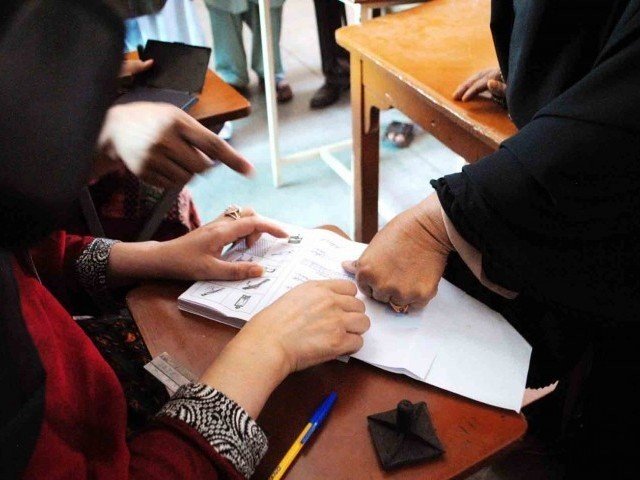
women voting in KP
By Raheela
PESHAWAR: “Our male relatives often go to great lengths to impose purdah rules and forbid us from going outside of the house. So participating in political rallies or poll campaigns becomes out of question,” laments Surraya Begum, known as Gul Bibi, of Dir district of Khyber Pakhtunkhwa, painting a stark portrait of the entrenched belief in Pakhtoon social fabric that a woman venturing outside of her home brings dishonor to the family.
Local traditions and customs in the Pakhtoon society continue to exert a profound influence on the participation of women in politics in the province, where traditional gender roles often confine women to domestic responsibilities.
In certain pockets of the erstwhile tribal areas and other districts of Khyber Pakhtunkhwa, women have been denied the right to cast their votes during recent elections, compelling the electoral watchdog, the Election Commission of Pakistan (ECP), to intervene and order re-polling in areas, like Lower Dir and Shangla districts, where, according to data on gender-wise turnout in the July 25, 2018 general elections, women voting remained less than 10 percent of the total votes at two National Assembly constituencies of Khyber Pakhtunkhwa (KP).
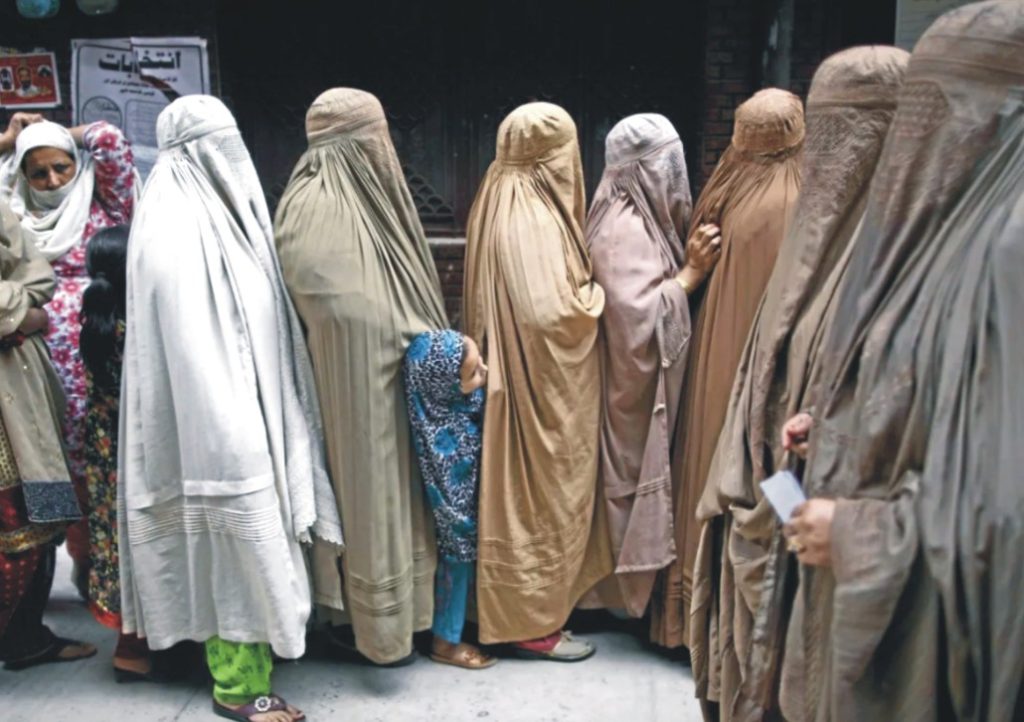
At NA-10 Shangla, only 9.66 percent of the total votes were polled by women, compared to 88.21 percent of male votes. In the by-election on PK-95, a constituency for the KP provincial assembly in Lower Dir, held on May 7, 2015, none of the around 53,000 women voters in the constituency had turned up to exercise their right to vote, according ECP statistics. The seat had fallen vacant after Jamaat-i-Islami chief Sirajul Haq resigned following his election to the Senate.
The Lower Dir constituency became the first case where the ECP annulled election results and ordered re-polling due to the absence of female voters.
According to the elections laws, if the turnout of women voters is less than ten percent of the total votes polled in a constituency, the ECP is supposed to declare the results invalid and order re-polling.
In the Pakhtoon code of life, or Pakhtoonwali, women must seek permission from their male relatives, like father, brother, son, husband, or other male guardians, in any activity outside their homes.
Major political parties have also yielded in the past to informal bans on women’s participation in the electoral process, which is evident from the Lower Dir election scenario.
According to the data from the Election Commission Pakistan (ECP), of the 128 million registered voters in the country, 59.32 million are women. The gender gap in voter turnout in KP has widened over the years as is evident from the statistics of previous elections.
Despite women, who constitute 49.6 percent of the total population of the country, their participation in elections remains around 20 percent, according to the official statistics.
The number of registered voters in Khyber Pakhtunkhwa is over 21.62 million of which 11.79 million are male while 9.82 million are female.
According to Pakistan Social Sciences Review (PSSR), June 2020, in the last few general elections, some of the political party’s candidates on behalf of local elders concluded agreements to stop females from casting votes, as is evident from the Lower Dir constituency, where under local arrangements, women were barred from voting.
“Due to the deep-rooted patriarchal traditions, particularly in the rural areas, women are not allowed by their husbands and fathers to cast their vote, which is evident from the election turnout in Shangla and Lower Dir districts,” said Zafarullah Khattak, a senior leader of Pakistan Tehreek-i-Insaf (PTI).
The province has witnessed a rise in female voters from 6,609,541 in 2018 to 9,861,698 in 2023. The increase is commendable, reflecting a positive trend in female voter registration.
Ayesha Rafique, a woman writer and political commentator hailing from Peshawar, highlighted the challenges women face in Khyber Pakhtunkhwa due to social norms. She said that reshaping societal attitudes and prototypical patriarchy towards women’s role in public life will require a multifaceted approach that would involve fostering a change in mindsets through community education and awareness programs.
As such, Jamaat-i-Islami has formed local committees to engage with women voters in the run-up to the 2024 general elections. These committees would conduct door-to-door campaigns to educate women voters on their right to vote.
“In KP, cultural barriers, like permission from male relatives to go to political rallies or poll campaigns, keep women away from using public space. Venturing out of home by women is considered dishonor for the family,” Ms Rafique said.
She says that the misinterpretation of Pakhtoon traditions and folk wisdom that women are the weaker sex and cannot shoulder political responsibilities becomes evident the moment a woman seeks to run for elections and the male-dominated society feels challenged.
In 2010, in some districts, like Lower Dir, Shangla, and North Waziristan, social pressure and harassment were employed to prevent women from contesting or voting in the elections by religious groups and political parties, resulting in the loss of approximately 650 seats in the local governments’ elections, according to the ECP statistics. Consequently, 32 union councils in Lower Dir, 38 in Kohistan, 20 in Battagram, 19 in Upper Dir, 11 in Swabi and 8 in Mardan had neither women representatives nor constituencies, statistics show. Background interviews reveal that women’s political empowerment was obstructed by religious groups and local chapters of political parties through clandestine understanding in various districts, including Swabi, Mardan, Swat, North Waziristan and Dir, from exercising their right to vote in the name of local traditions and customs.


