General Elections 2024, PK-82 constituency Peshawar
By Muhammad Khurshid
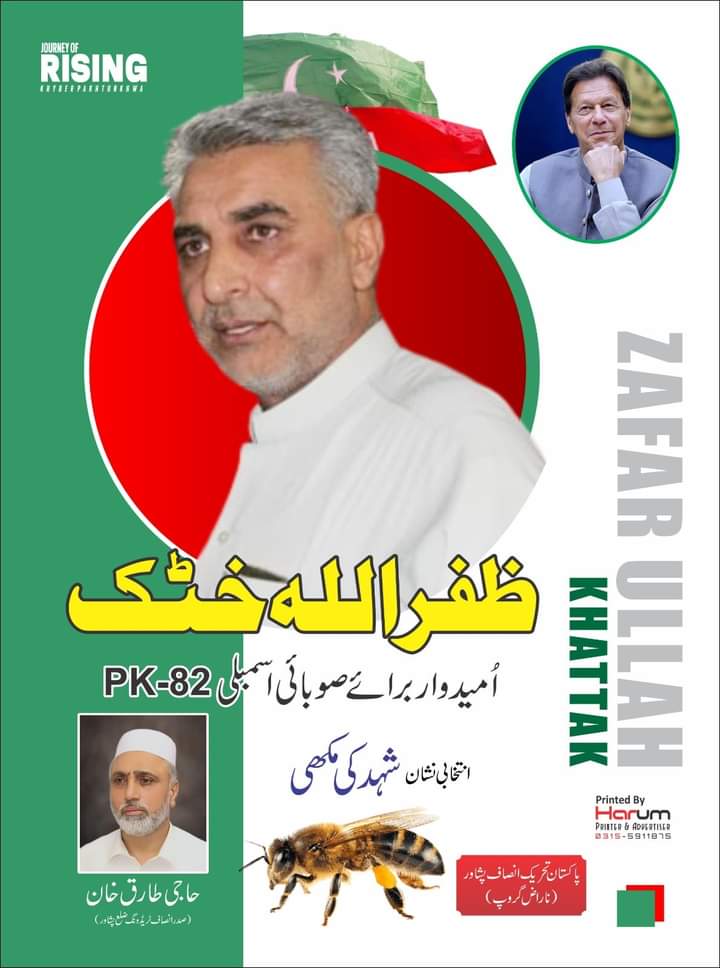
PESHAWAR: The political landscape in Peshawar has witnessed a significant upheaval, as a senior leader of Pakistan Tehreek-i-Insaf (PTI) Zafarullah Khattak, an independent candidate from PK-82, raises his voice against the alleged compromises on the principles of transparency and accountability within the party
With a 28-year-long struggle in Peshawar, aligning with the ideology of Imran Khan, he sheds light on the challenges he faced and the ideological contradictions within the party.
Zafarullah Khattak’s narrative revolves around his unwavering commitment to the ideology of Imran Khan, the founder chairman of PTI. His struggle reflects his dedication to the principles of justice, anti-corruption, and fairness in governance.
Zafarullah Khattak questions PTI workers and youth on the moral dilemma of voting for a candidate who may lack transparency and possess a tainted record. He challenges the practice of favoring certain individuals with party benefits, including ticket allocations, and advocates for a more transparent and merit-based approach in PTI’s candidate selection process.
Khattak emphasizes that he stood with Imran Khan during times when the party called for a voice against wrong and corrupt elements. However, he raises concerns about the internal dynamics of PTI, asserting that instead of purging the party of corrupt elements, they are being strengthened by receiving tickets again.
A significant blow to PTI’s stronghold in erstwhile UC One came with its division into two parts, added to Chamkani tehsil. Khattak questions the silence within the party ranks when this division occurred, leading to the dilution of PTI’s influence in the region.
The impact on PTI’s vote bank, evident in the defeat in the Peshawar municipal election, underscores the repercussions of internal party politics on the broader political landscape.
Khattak highlights the neglect of PK-82 Peshawar by elected representatives in the previous regime, resulting in the Union Council’s deterioration.
The absence of basic facilities, such as proper waste management and consistent gas and electricity supply, points to the larger issue of governance and accountability within the political structure. Khattak calls out the role of former elected representatives in exacerbating the problems faced by the residents. The inclusion of certain areas, like Kamboh, Paharipura, and Sikandarpura, into Chamkani Tehsil had a direct impact on PTI, leading to a fragmented vote bank.
He underscores the failure of PTI’s representatives to address this issue, contributing to the party’s electoral setback in the region. The narrative reflects not only on the internal party politics but also on the strategic decisions that have affected PTI’s standing in Peshawar.
Zafarullah Khattak’s struggle for change in PK-82 Peshawar encapsulates the challenges faced by individuals within political parties who strive to uphold the founding principles against internal compromises.
The narrative not only sheds light on the internal dynamics of PTI but also raises broader questions about governance, accountability, and electoral strategies that impact the welfare of constituents. As Peshawar navigates through these challenges, the voice of candidates like Khattak becomes crucial in shaping the future trajectory of PTI and the broader political landscape.
About The Author